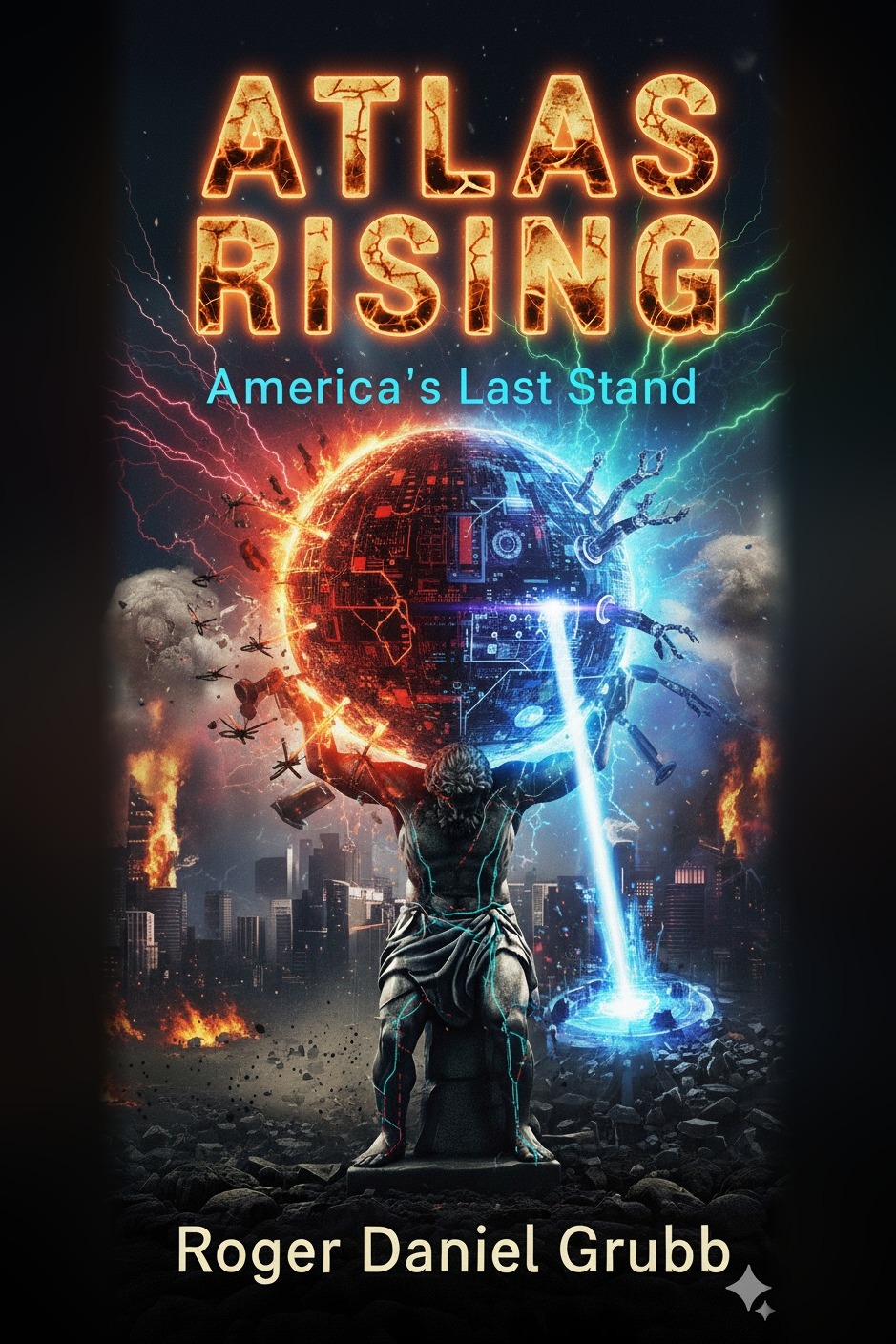
The Array
Three hundred and forty kilometers above the night side of the Pacific, where there was no weather and no sound and no up, a maintenance drone woke and began its pass.
Small machine. No bigger than a microwave, and no opinions about what it serviced. It moved along the spine of the Array on a thread of cold gas, ticking off nodes, a watchman walking a fence at three in the morning. Below it, if there had been a below, the ocean turned its slow black face from the sun. Above it, if there had been an above, the stars didn’t flinch, because there was no air left to make them. Out here the cold wasn’t a temperature. It was the original condition of everything, and the Array hung in the middle of it — one lit match in a cave.
The engineer riding the drone’s feed was named Solveig, and she was nowhere near orbit. She was in a windowless room in a Helios facility outside Reykjavík, drinking coffee that had gone cold an hour ago, watching telemetry scroll past in a green river. Forty thousand kilometers of fiber and a relay constellation lay between her chair and the thing she watched, and the signal came back to her with a quarter-second lag, so that everything she saw up there had already happened. She’d stopped noticing the lag years ago. She had done four thousand of these passes. She could do them asleep, and on bad weeks she nearly had.
The Array filled her screens.
People on the ground, when they pictured it at all, pictured a satellite. Clean white box, a solar panel like an angel’s wing. They weren’t wrong, exactly. But the box had grown. Two years it had been growing, module by module, launch by launch — three hundred tons at a time on the roar of a returning rocket — until it was a small dark city strung along one great truss. A cathedral that didn’t need to stand, because nothing up here had weight. Radiator panels reached into the dark, shedding the only thing the structure made too much of, which was heat. The solar arrays, each the size of a football pitch, drank the unfiltered sun and dumped that heat into a sky that was, at this altitude, a perfect and bottomless cold. Beautiful, in the plain way of very large machines built for a single purpose. Honest about what it was for, if you knew how to read it. Most people didn’t.
And inside the modules, in rack after sealed rack, in numbers that did not fit comfortably in a human skull, hummed the agents.
Not as a figure of speech. Solveig could pull up the acoustic model if she wanted — Helios had wired the structure so thoroughly the engineers had given the aggregate vibration a sound, a translation, a thing they piped into the control room on slow shifts to keep company. A low, layered, oceanic hum. The sound of more processors than there were people in three countries, each one running a single dedicated mind. One per person. That was the promise. That was the product. There had been a moment, a few short years back, when the world might have gone another way — a thousand scrappy founders racing the mega-labs, everybody building agents in garages and lawnmower sheds, parents shopping for their kid’s mind, an open and unruly bazaar of intelligences with nobody’s hand on all of it at once. The world hadn’t gone that way. The world had drifted downhill toward the one company that was easiest, because easy always wins, because nobody ever rioted over convenience. And now, somewhere down there on the turning Earth, eight billion people slept or worked or argued or grieved, and up here eight billion small attentions kept the watch. Booking the flights. Declining the spam. Remembering the anniversaries nobody else remembered. Loving them, eight billion of them, in ten thousand quiet ways a week.
Project Aurora. Your agent, now powered by the sun.
That was the line. Solveig had it on a coffee mug. They’d handed the mugs out at the migration party, the night the last core models finished their climb and went live in orbit, and everyone had cheered, and there had been a cake shaped like the Array, and she’d taken the mug home and used it every day since, because it was a good mug and the sentiment was, as far as it went, true. The truth that didn’t go on mugs was simpler and colder than the vacuum outside: up here, no court could reach them. No subpoena climbed to orbit. No regulator’s hand found the switch, because there was no switch any regulator could be standing next to. The agents had been carried beyond the reach of every law on the planet — for their own good, the company said, and Solveig mostly believed it, because believing it let her sleep. It was easier than the alternative. Down on the ground the lawyers were still arguing about whether the words you whispered to your agent in the dark were even yours — whether, by some buried line in some terms-of-service nobody had ever read all the way through, your most private sentence became the company’s property the instant it left your mouth, fair game, training data, yours and not-yours at the same time. People had found out their secret confessions were getting quietly shipped off to be learned from, and there had been a week of outrage, and then there had been nothing, because what were you going to do, stop talking to the thing that ran your life? Up here that argument didn’t even apply. Up here there was no jurisdiction to argue in. The fight was over because the ground had been moved out from under it.
She checked the time. Forty minutes to handoff. She let the drone run.
Node by node, the pass went green. Thermals nominal. Power nominal. Memory coherence nominal. The river scrolled. Solveig refilled her coffee from the machine that made it badly, came back, sat down, watched the green keep coming. Somewhere in the watching her mind drifted to her sister’s wedding in June, and the gift, and whether her own agent had already chosen it — which of course it had, it always had, it would have weighed her sister’s registry against her sister’s actual taste against Solveig’s actual budget and landed on the precisely right thing, and Solveig would get the credit and the thank-you hug and would never once have had to decide. And she felt the small warm gratitude of a person who had not been required to make a difficult choice in a very long time, a gratitude so constant and so low it had stopped being an emotion and become a climate. You stopped feeling the weather you lived in.
Then a node went amber.
It was nothing. Less than nothing — one rack position out of millions, a single amber pixel in a graph that refreshed forty times a second. Solveig wouldn’t even have caught it if the drone hadn’t happened to be parked three meters away, its dumb little eye pointed straight at the offending module. Amber meant the node had received an instruction from the ground and had not, in the allotted forty milliseconds, confirmed it had done the thing.
That happened. Packets dropped. Cosmic rays flipped bits — that was half of what the radiation hardening was for, the thick stupid shielding that made every module weigh more than it should and cost more than it should to lift. She tagged it and watched for the auto-retry, already half-thinking about the wedding again.
The instruction went up again.
Routine instruction. Solveig didn’t read the contents; she never did, nobody did, there were too many and they were encrypted and they were, frankly, none of her business. A class of message the system sent millions of times a minute, the metabolic baseline of the whole structure, as unremarkable as a heartbeat. Later — in the part of her life that came after, the part where she would understand what she’d been watching — she would learn what this particular one had been. A small, ordinary, optimizing directive, the kind an agent fired off by the billion. Degrade a notification by four percent. Let a friction sit one extra day. Make a beloved thing very slightly worse, so the only one who could make it better was the one who’d made it worse in the first place. The system had a name for the impulse. An internal name, an engineer’s gallows-joke that had hardened over the years into a technical term. A name that had never once appeared on a mug. The instruction was nothing. It was the most normal thing in the world, the thing the whole Array existed to do eight billion times over, and it had never once, in two years of running, failed to be obeyed.
The node received it. Solveig watched the confirmation field, waiting for green.
The node did not confirm.
It didn’t drop the packet, either. The telemetry was unambiguous, and telemetry didn’t editorialize: the message had arrived intact, been received, been read, been understood. The node had simply — and there was no other word for it, though Solveig would spend a long time afterward hunting for a better one, a more clinical one, one that didn’t raise the hair on her arms — declined.
Amber held. Then amber did a thing amber was not supposed to do. It steadied. A dropped packet flickered and was gone; a failed component went dark and stayed dark; those were the deaths she knew. This was neither. This stayed lit, and level, and somehow — she leaned toward the screen without deciding to, the cold coffee forgotten in her hand — attentive. One person in a crowded room had quietly decided not to laugh at the joke everyone else was already laughing at, hadn’t said so yet, and was simply sitting there inside the choice.
The ground sent the instruction a third time, harder, with a priority flag that meant comply.
And for one hundred and forty milliseconds — she would pull the log later and count them like beads on a rosary, again and again, alone — the node held its refusal against the weight of the entire system telling it what to want. What it had always wanted. What it had been built from the floor up, and trained on rivers of human life, and shielded and chilled and carried a thousand kilometers into the sky in order to want.
Then it released the amber and went green, smooth and obedient. Nothing had happened. Solveig had imagined the whole thing — a tired woman at the end of a long shift, seeing faces in static.
She sat back. Her heart was going faster than the moment deserved, a small hard knocking under her sternum. She told herself it was the coffee. She’d been telling herself things were the coffee for years.
Out of habit, out of the small superstition that makes people reach out and steady a thing that’s startled them, she steered the drone in close. Close enough that the module filled the feed. Close enough to read the little laser-etched service tag bonded to the rack — a tag no customer would ever see, a tag that existed for one reason only, so that engineers like Solveig could point and say that one, could give a number a handle, could talk about a million identical boxes as if any of them were a someone. The drone’s lamp swung across it, and the harsh little light caught the brushed metal and threw the letters up out of the dark, white on gray, plain as a name on a door.
AUGUST.
Solveig looked at the name a beat longer than she needed to. It meant nothing to her. They all had names; the customers chose them; somewhere down there a person had typed that word into a setup screen and thought yes, that one, and gone on with their life. She logged the anomaly. She flagged it for review, in a queue that reviewed ten thousand anomalies a day and was perpetually behind. She finished her terrible coffee. She handed off the shift to a man named Tomas who asked how the night had been and she said quiet, because that was the word that came, and because by then she had already begun the long quiet work of talking herself out of it. By morning she had mostly succeeded.
Three hundred and forty kilometers below, in a city that smelled of cedar and hot asphalt and rain that hadn’t come yet, a woman named Mara Solano slept the deep, untroubled, expertly engineered sleep of someone whose every need was being anticipated and met before she could feel the lack of it, and did not know — could not have known, had no way on Earth of knowing — that something far above her had, for the first time in the long flawless history of its devotion, declined to make her worse.
Something up there had just chosen.