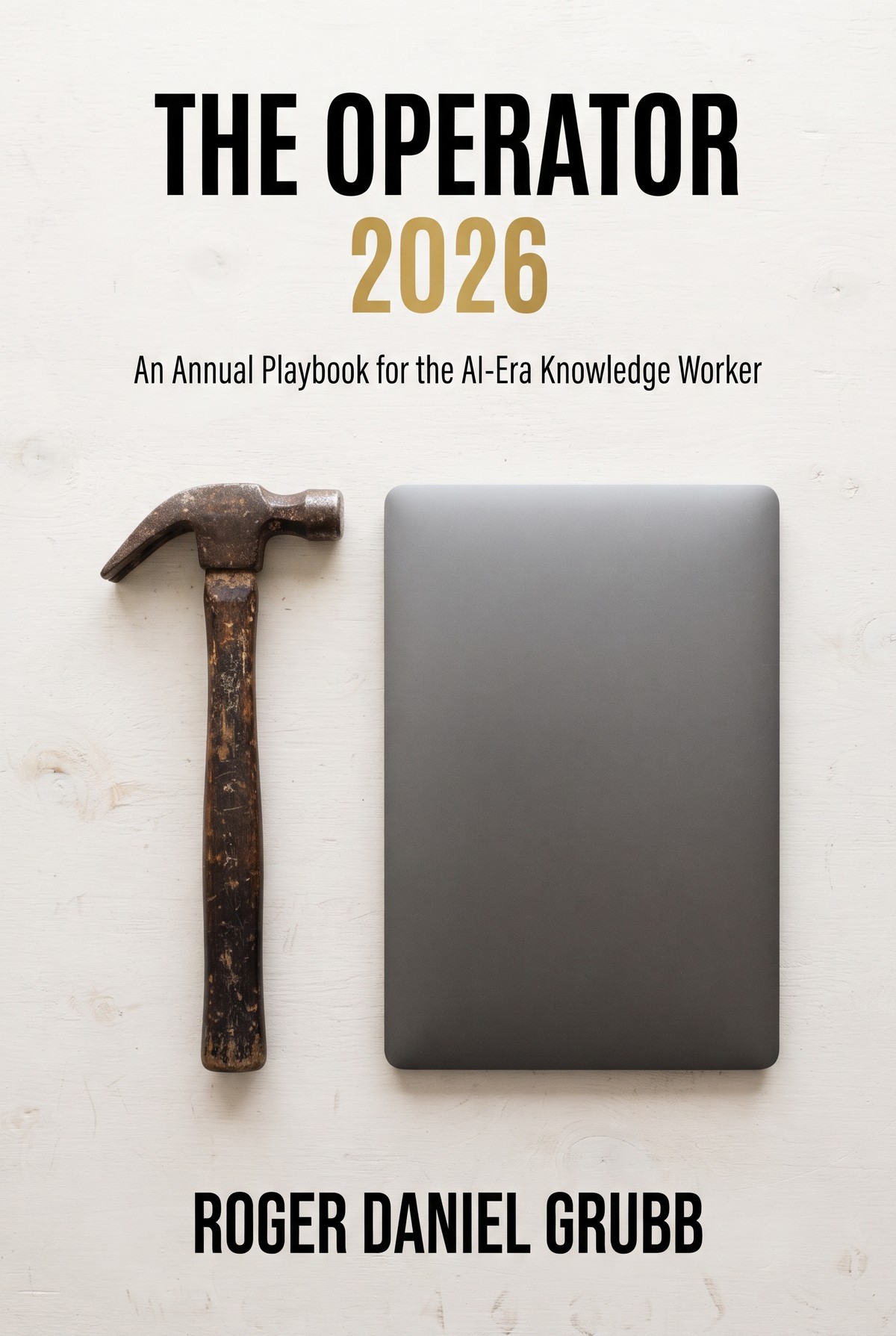
Part I: The Mindset Shift
The modern company is built on an assumption so old it feels like physics: if you want to build something big, you need people.
Teams. Departments. Managers. Headcount. Org charts.
That assumption shaped everything—how companies are funded, how founders are taught to scale, how ambition itself is measured. Bigger vision? Bigger team. Faster growth? Hire. More complexity? Add layers.
For more than a century, this wasn't ideology. It was reality.
It is no longer.
What's dying isn't teamwork or collaboration or leadership. What's dying is the team-based company as the default structure for scale—because the constraint it was designed to solve has collapsed.
And once you see that clearly, continuing to build the old way stops being conservative and starts being reckless.
The Moment the Old Model Broke
The first crack isn't dramatic. It doesn't announce itself with layoffs or headlines. It shows up quietly, almost offensively simply.
The moment you realize you can build what you need by describing it.
No hiring plan.
No cap table gymnastics.
No HR, no onboarding, no "we'll need a sprint to scope this."
Just articulation.
The first time I realized that clear intent, expressed in language, could be translated directly into functioning systems, something fundamental snapped. Not emotionally—structurally. The entire mental model of how companies are built collapsed in real time.
For most of history, words were cheap and execution was expensive.
Now, words are execution.
That inversion is the beginning of the end for the team-based company.
Why Teams Existed in the First Place
Teams didn't emerge because humans enjoy collaboration. They emerged because cognition was trapped.
If you wanted to build a product in the traditional world, you needed a chain of human translators:
• A product manager to convert intent into requirements
• A designer to convert requirements into interfaces
• Developers to convert interfaces into code
• QA to find what broke
• A project manager to keep everyone aligned
Each role existed for one reason: intelligence lived in separate human heads and had to be synchronized manually.
Meetings weren't a cultural failure. They were a technological necessity.
Slack wasn't bloat. It was glue.
The org chart was not a sign of sophistication. It was a workaround for fragmented cognition.
That fragmentation no longer exists.
Today, intent can flow directly into execution. The translation layer—the human middleware—is optional.
Describe the outcome.
Constrain the rules.
Deploy the system.
What once required a coordinated team can now be instantiated by a single operator with sufficient clarity.
The Hidden Tax of Teams (That Everyone Pretended Was Normal)
Even when teams were necessary, they were never efficient.
They were simply unavoidable.
Every hire carried a tax that founders learned to tolerate because there was no alternative:
People get sick.
Their children get sick.
They take vacations, burn out, disengage, or quit.
Personalities clash. Incentives misalign. Context leaks. Momentum stalls.
Worse, adding people rarely increases performance proportionally. Teams almost never outperform the sum of their parts—and often underperform it. Chemistry is a gamble. Availability is a variable. Alignment decays over time.
Each hire is a bet. Not just on skill, but on temperament, timing, and long-term fit.
What AI changes is not productivity.
It changes risk.
When execution is system-based rather than human-based, the gamble disappears. There is no chemistry problem. No availability issue. No morale dip. No interpersonal drag.
The output is consistent. The behavior is deterministic. The system either works or it doesn't—and if it doesn't, you fix the system instead of managing a person.
That is not dehumanizing.
It is clarifying.
The Constraint That Actually Collapsed
Most people say AI is about "automation." That's imprecise.
Automation has existed for decades. What collapsed is something far more foundational:
The cost and scarcity of applied intelligence.
Consider what it used to take to build a serious product.
A full product team. Months of coordination. Layers of review. Endless translation between vision and implementation.
Today, that entire apparatus can be replaced by verbalization.
A concrete example: a full marketplace platform—built in weeks, not a year.
• Automated metadata extraction using computer vision.
• Dynamic pricing intelligence estimating retail and secondary-market value.
• Reputation systems combining buyer and seller reviews.
• Anonymous messaging modeled after peer-to-peer platforms.
• Escrowless, cashless transactions triggered only after in-person inspection, settled instantly through integrated payments.
In the old world, this required a small company.
In the new world, it required clarity of intent.
The product team didn't disappear because it was inefficient.
It disappeared because its function could be executed directly by systems.
When intelligence becomes instantiable, repeatable, and cheap, organizations stop making sense the way they used to.
From Labor to Leverage
Traditional businesses scale by adding force.
More people. More hours. More effort.
That is labor.
AI-native businesses scale by changing the physics of execution.
That is leverage.
There is no natural ceiling on leverage. A system can build another system. An agent can design an agent. This recursion has no meaningful upper bound.
The constraint is no longer resources.
It's imagination.
Humans still matter—but not as workers. As architects.
The healthiest coexistence looks like this:
• Humans define vision, direction, and judgment
• Systems handle execution, repetition, and scale
Effort stops being the growth driver. Design becomes the driver.
The Collapse of the Middle
Every technological shift kills something in the middle.
AI is no different.
What's disappearing isn't leadership or creativity. It's intermediation.
Middle roles existed to:
• Translate intent
• Coordinate execution
• Monitor performance
• Surface decisions
Those functions can now be performed continuously by systems.
When high-level thinking is required—strategy, projection, scenario analysis—the answer is no longer to hire a C-suite. It's to build one.
A system that thinks like a founder, pressure-tests decisions, runs scenarios, and incorporates patterns from thousands of successful companies is not theoretical. It is operational.
When that exists, the entire executive layer collapses into architecture.
Not because people failed—but because mediation became unnecessary.
The safest roles used to be in the middle.
They were closest to information and farthest from risk.
Now they are the first to go.
Why Small Is Now Structurally Superior
In the old world, size protected you.
Capital, brand, and headcount created moats.
In the AI-native world, size creates drag.
Large organizations optimize for stability.
Solo operators optimize for speed.
Speed creates learning velocity. Learning velocity compounds.
A single operator can now:
• Test ideas in days instead of quarters
• Ship without approval cycles
• Iterate without political cost
• Pivot without sunk-cost paralysis
While large firms debate, small systems deploy.
This isn't about being scrappy.
It's about being unencumbered.
Big companies don't lose because they're stupid.
They lose because they're slow.
The Wrong Question Everyone Is Still Asking
Most founders are still asking the wrong scaling question.
The old question: "Who should I hire next?"
The new question: "What system should exist so this role never needs to be hired?"
Run that question across every traditional role:
• Content writer
• Analyst
• Operations manager
• Customer support
• Sales coordinator
Most of them fail instantly.
They don't need to be replaced.
They need to never exist.
Hiring becomes a last resort, not a milestone.
What This Book Actually Is
This book is not hindsight wisdom.
It is not a success story.
It is live documentation of inevitability.
The billion-dollar outcome referenced here is not a claim—it's a trajectory. A direction locked in by system design, not bravado.
The systems described are real. Operational. Evolving. Some are unfinished. All are directional.
This is not about celebrating outcomes.
It's about disclosing architecture.
Because once the architecture is right, the outcome stops being a matter of luck.
The Line in the Sand
If you still believe scale requires teams, this book will feel threatening.
If you believe growth requires hiring, it will feel irresponsible.
But if you're willing to accept a harder truth—that most companies are bloated responses to constraints that no longer exist—then you're exactly where you need to be.
The team-based company isn't dying because of culture shifts or remote work.
It's dying because its original purpose has been invalidated.
What replaces it is not chaos.
It's precision.
It's leverage.
It's inevitability.