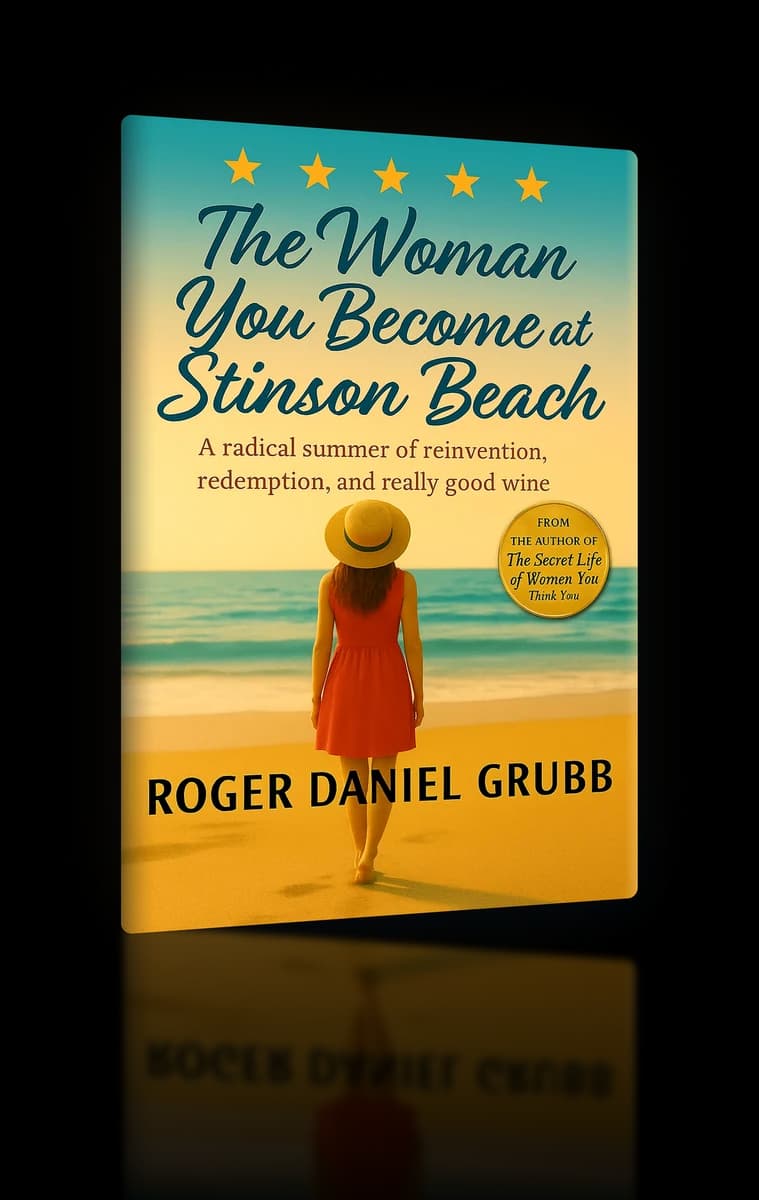
Chapter One: The Banana Bungalow
Narrated by Zoe
Ryan said "love you" from the couch at 7:40 on a Tuesday night, without looking up from his iPad.
At 7:41, the woman he'd slept with the night before texted him.
I know the exact minute because I was standing behind the couch with a box of pork dumplings, trying to find something on Netflix we hadn't already fallen asleep to, and her message slid down from the top of his screen eighteen inches from my face.
Last night was so worth the risk. Again?
Her name was Cori. With an i.
I ate two dumplings before I said anything. I'm not proud of that. I'm not ashamed of it either. They were good dumplings, and some part of me knew they were the last normal thing I was going to do in that apartment.
Ryan felt me go still. He looked at the screen, then up at me, then at the screen again. He had the face of a man doing math.
"Zoe. That's not what it—"
I set the box on the counter. I took off my ring and set it next to the box. Then I picked up my keys and my laptop bag and walked out. I didn't scream. I didn't cry. I didn't slam the door, because it was a soft-close door that cost four hundred dollars, and Ryan had picked it out specifically so nobody could ever slam it.
In the parking garage, "Landslide" came on the car radio. I turned it off and sat there until the garage lights dimmed to their night setting.
* * *
One week later, after a panic attack in a Whole Foods parking lot and two glasses of Sancerre, I booked a place called The Banana Bungalow.
It was three cottages on a hill above Stinson Beach, an hour north of San Francisco, which is close enough to drive and far enough that nobody from Palo Alto drops by. The name was so dumb it felt safe. I booked two weeks. Maybe three.
I want to be clear about what I was not going there to do. I was not going to heal. I was not going to journal my way to a breakthrough or find myself in a tide pool. Women in linen pants do that in Tuscany. I was going to turn off my phone and stop being someone people needed answers from.
For ten years I had been half of a couple people envied. Ryan was a founder, one of those men who says "disruptive flow mapping" on stage and can't remember your anniversary. We used to talk about art. Then we talked about workflows. I was technically still a UX designer, which in our world meant I made slides about things I didn't care about for people I couldn't stand. The last project I'd been proud of involved glue sticks. It was in third grade.
Nobody tells you the collapse is quiet. It doesn't explode. You just keep smiling at dinner parties while you slowly turn into someone you would have swiped left on.
* * *
The Banana Bungalow sat above the beach like it knew something. Yellow siding. Teal shutters. Three small cottages climbing the hill behind the main house. My rideshare smelled like Axe body spray, and the driver didn't speak once, which I tipped him extra for.
A wooden sign on the gate said:
Come as you are. Stay until you remember who that is.
My cottage was called The Lemon Tree. I was punching in the lockbox code when a voice came out from behind a bush of rosemary.
"Hey, heartbreak refugee. You drinking that wine alone, or should I bring a second glass?"
I hadn't told anyone why I was there. I turned around.
A woman stood barefoot in the herb bed in a tiger-print caftan, holding a bottle of red in one hand and a lemon in the other. Silver curls. Bronze skin. The eyes of a woman who had buried at least two husbands and wasn't taking questions about it.
"Margo," she said, and held out the hand with the lemon in it, so I ended up shaking the lemon. "I own this circus."
"Zoe."
"I know. You booked under your married name and then changed it to your maiden name forty minutes later." She smiled. "You'll fit right in."
Inside The Lemon Tree there was a welcome basket: dark chocolate, olive crackers, a half-bottle of Chardonnay, and a card in big, confident handwriting.
Don't let your story end here. Rewrite it. —M.
I poured the wine, stood barefoot at the window, and watched the ocean. My phone was on airplane mode. I didn't plan on changing that.
For the first time in a week, I took a full breath.
* * *
That night Margo threw a party on the deck of the main house, which I found out later she does every time a new guest arrives. Edison bulbs strung through the cypress trees. Oysters on a grill. Jazz coming out of a Bluetooth speaker that was too loud for background music.
There were two other guests.
Teresa was older than the rest of us and had a paperback of Mary Oliver open on her knee. Every few minutes she read a line out loud to no one in particular, then went back to her wine.
Elise had arrived from Atlanta that afternoon. She sat at the far end of the table in a white shirt with no wrinkles in it, drinking sparkling water. When she reached for an oyster, she checked the edge of the shell with her thumb first, the way you check a contract for the clause that's going to hurt you.
Margo leaned over to me. "Hot divorcée number two. Watch her pretend she came for the view."
Around ten, Margo stood up with her glass. "House rule. Everybody says why they're here. One sentence. You can lie, but I'll know."
Teresa said, "My children think I'm at a yoga retreat."
Elise said, "I needed to leave."
Margo looked at me.
I hadn't planned to say anything true. I'd planned to say "Work stuff." What came out was this:
"I spent ten years turning into the woman Ryan wanted, and I don't remember who was there before."
Nobody said "I'm sorry." Margo raised her glass about an inch.
"There it is," she said.
* * *
The next evening I took a glass of wine over to Elise's porch. Her cottage was The Blue Heron, the nicest one, and she was sitting outside it with a steel thermos that could have held matcha or a restraining order.
"You settling in?"
"Yes. Thank you."
"What brought you out here?"
"I told you. I needed to leave."
"Leave what?"
She took a long time to answer. "Atlanta." Another pause. "Husband stuff."
"Nobody here makes you tell the whole story," I said. "But when you're ready, we've got oysters and very bad boundaries."
The corner of her mouth moved. It wasn't a smile yet. It was the start of one.
* * *
Raya arrived the day after that with one duffel bag and a notebook. She was young enough that at the Banana Bungalow she counted as a toddler. She stopped at the gate and stood there for a full minute, reading the sign, like she was waiting for it to tell her something more.
Margo raised a lemon at her from the porch. "You're not too young. You're just early."
Raya blinked. "Sorry?"
"You'll get it by Tuesday."
Raya got The Lavender Shed. Inside an hour she had rearranged its spice rack by mood.
"Cardamom is memory," she told me, holding up the jar. "Cayenne is a scream in lipstick."
"I can't decide if I want to mentor you or tape your mouth shut," I said.
She laughed like nobody had ever told her to be quiet. I liked her immediately and resented her a little for it.
That night the four of us sat on Margo's porch. Margo lit a joint, took one drag, and passed it to nobody.
"You know what's better than healing?" she said. "Quitting the performance. You all came here because you got tired of starring in a life you didn't write. This place won't fix you. It just lets you stop pretending you're fine."
Elise looked at the ocean. Raya wrote it down. I drank.
But something had shifted. We weren't strangers who happened to share a deck anymore. We were four women who had stopped lying about what we came here to get away from.
* * *
At 11:58 that night I turned off airplane mode. I told myself it was to check the time.
Forty-three texts. Most from Ryan. Two from my mother, who had found out from Ryan. One from my boss asking if I could "jump on a quick call Thursday."
The last one from Ryan had come in that evening.
I keep reaching for you in my sleep. I know I don't get to say that. I'm saying it anyway.
I read it four times. I typed a reply that was cruel and a reply that was forgiving and a reply that was just ok, and I deleted all three. Then I opened his contact and pressed Block, and the phone asked me if I was sure, and I was.
I wrote one entry in the journal I'd brought as a joke.
Leaving was the easy part. Staying gone is the hard part. Especially when he finally says something that sounds like he means it.
Also: buy more Chardonnay.
I slept nine hours. I hadn't done that in a year.
In the morning, somebody knocked on my door.
Margo doesn't knock. Margo just shows up.
◆ ◆ ◆